
Command Palette

Search for a command to run...

Overflow scroll gradient

Published
2 min read
F
I am an Infrastructure and DevOps Engineer specializing in designing, building, and operating scalable, secure, and highly available cloud infrastructure. My core focus is on Microsoft Azure cloud platforms, Infrastructure as Code (IaC), and DevOps automation to support reliable production systems. I work across cloud infrastructure engineering, DevOps practices, and site reliability engineering (SRE) principles to ensure systems are resilient, observable, and optimized for performance, cost, and scalability. My experience includes designing and managing cloud environments across compute, networking, storage, identity, and security layers. I build Infrastructure as Code solutions using Terraform and Azure Resource Manager (ARM) templates to automate provisioning, configuration, and deployment of cloud resources. I am actively involved in improving system reliability through monitoring, logging, and incident response processes using tools such as Azure Monitor and cloud-native observability solutions. I also participate in on-call operations, production support, and incident management to ensure high availability of critical systems. Security is a core part of my engineering approach. I work with identity and access management (IAM), Azure Active Directory, and cloud security best practices to ensure infrastructure remains compliant, secure, and audit-ready in line with industry standards such as ISO 9001 and ISO 27001. I collaborate with cross-functional teams including software engineers, DevSecOps, and product teams to deliver infrastructure solutions for customer-facing applications and enterprise platforms. My technical interests and growth areas include: Cloud Infrastructure Engineering (Azure, AWS, GCP) Site Reliability Engineering (SRE) Platform Engineering Kubernetes & Container Orchestration Infrastructure as Code (Terraform, ARM) CI/CD Pipeline Automation Distributed Systems & System Design Cloud Security & Identity Management I am passionate about building systems that are not only scalable and efficient but also reliable and easy for engineers to use. I am continuously growing my expertise toward senior-level Infrastructure, SRE, and Platform Engineering roles, including global remote opportunities.

Overflow scroll gradient

Adds a fading gradient to an overflowing element to better indicate there is more content to be scrolled.

Code Samples:

HTML

<div class="overflow-scroll-gradient">
  <div class="overflow-scroll-gradient__scroller">
    Lorem ipsum dolor sit amet consectetur adipisicing elit. <br />
    Iure id exercitationem nulla qui repellat laborum vitae, <br />
    molestias tempora velit natus. Quas, assumenda nisi. <br />
    Quisquam enim qui iure, consequatur velit sit? <br />
    Lorem ipsum dolor sit amet consectetur adipisicing elit.<br />
    Iure id exercitationem nulla qui repellat laborum vitae, <br />
    molestias tempora velit natus. Quas, assumenda nisi. <br />
    Quisquam enim qui iure, consequatur velit sit?
  </div>
</div>

CSS

.overflow-scroll-gradient {
  position: relative;
}
.overflow-scroll-gradient::after {
  content: '';
  position: absolute;
  bottom: 0;
  width: 240px;
  height: 25px;
  background: linear-gradient(
    rgba(255, 255, 255, 0.001),
    white
  ); /* transparent keyword is broken in Safari */
  pointer-events: none;
}
.overflow-scroll-gradient__scroller {
  overflow-y: scroll;
  background: white;
  width: 240px;
  height: 200px;
  padding: 15px;
  line-height: 1.2;
}

Output
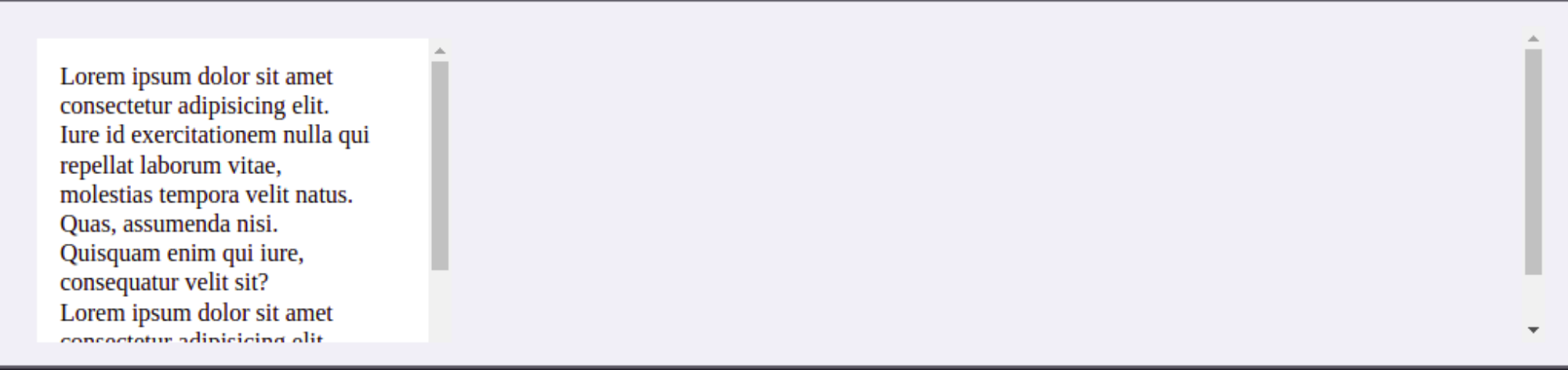
ab.png

Brief Explanation

  • position: relative on the parent establishes a Cartesian positioning context for pseudo-elements.

  • ::after defines a pseudo element.

  • background-image: linear-gradient(...) adds a linear gradient that fades from transparent to white (top to bottom).

  • position: absolute takes the pseudo element out of the flow of the document and positions it in relation to the parent.

  • width: 240px matches the size of the scrolling element (which is a child of the parent that has the pseudo element).

  • height: 25px is the height of the fading gradient pseudo-element, which should be kept relatively small.

  • bottom: 0 positions the pseudo-element at the bottom of the parent.

  • pointer-events: none specifies that the pseudo-element cannot be a target of mouse events, allowing text behind it to still be selectable/interactive.

Thanks for reading...

Happy Coding!

More from this blog

Building Reliable Systems

93 posts

Insights on Infrastructure, DevOps, SRE, and building reliable systems at scale.